Wednesday, December 02, 2009

All you can do yourself with (raw) milk


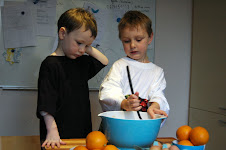
This is my home made cheese. Looks a lot like those made in abruzzo by handy housewives with a farming background, but it is absolutely different. It is no ricotta, as it may seem, but labna. Tastes lots like a stracchino made from yogurth.

The following recipies are as strange to Abruzzo as you can imagine, but it is my village youth in Ofena and Tortoreto, I believe, to get me the feeling for self production. It all started with the discovery that at a 10 minutes drive from my hous in Amsterdam (the Netherlands) there was an organic farm. For all romantic fall pictures please see here.

Had I known of this when my mom found out in Ofena that the lady keeping sheep and goats (and winning every year the contest of most beautyful ram of the region) could provide us with raw, fresh milk. We used to bring her a 1,5 liter recycled ice-tea bottle, as it had a larger opening that regular bottles, and she had a goat who made daily just about that quantity. Back then I was giving my baby goat milk from the supermarket, because I suspected him of being sensitive to cow-milk.

Raw milk is now becoming a trend, and what I love about Italy is that more and more farmers do get a milk-tap machine, and install it in different crowded paces, so you can go day and night to pick up you own milk in your own bottle. They recommend you boil it to about 72 Celsius before drinking, but we don't, and so it tastes so much better.

Yogurth
To make yogurth you need any amount you like of milk (supermarked milk is OK too), a starting colture of yogurth (can be bought the first time, or you can save everytime a cup for the next batch), a pan with a good fitting cover (I use the pressure-pan as the cover can be closed perfectly) and an old blanket, sleeping bag, sweaters, whatever you want to keep the pan warm.

You start by boiling the milk and then let it cool down until you can keep your kand in it and count to 10 without burning yourself (about 45 degrees Celsius).

Than you add the yogurth (about 3-4 cups per gallon), mix, cover the pan, wrap it in the blankets and put it to rest in a quiet place. Usually I put it under my bed so that nobody will be bothered by it. You let it stay for about 12 hours, so I usually start warming up the milk while cooking dinner, and have my yogurth ready for the next breakfast. you might want to mix it when ready.

I know of people making yougurth in a thermos, and thus saving themselves all the trouble with blankets etc. but I use it to make chesse as well, so I need lots.

Labna-cheese
Take any quantity if yogurth you want to use, considering that the volume of the cheese will be at least 4-5 times less than the volume in yogurth. Add salt to taste (if you use little salt, and Americans usually do that, compared with South-Europeans, add more than you would consider OK). Mix well.

Prepare a strainer, rinse with lots of water a clean white cloth (otherwise your cheese will taste of softener, which you don't want. Ideally you wash your cheese cloth only with hot water), put the cloth inside the colander and pour your salted yogurth in it. Hang the strainer on top of your sink or put it inside a bowl deep enough to collect all the water leaking from the cheese, without having it hanging in it. Consider that lots of water will come out.

My kitchen used to be unheated during the day, so I did it just on a table. you might want to hang the hole thin in th fridge. In this case, don't use the colander, but tie well the cloth and hang it above the bowl. I know someone who bought especially for the cheese a clean white cotton sock (if you can find unbleached cotton, than you deserve the organic-housewife of the year award), as it avoided mess and it hung so much more easily.

After a few hours all the excess water left. ;eaving behing a creamy cheese. I scoop it away from the fabric with a spoon, press it in a small bowl, and keep it in the fridge. Before serving I turn it on a small plate or saucer and serve it. The one in the picture was made with 3 lt. milk and had a diameter of 15 cm at the base.

I eat it spread on bread or crckers, and as a lean alternative to sour cream in soups or other dishes. Keep in mind that it is salty, so the dish should not have much salt on its own. I love it with pumpkin soup, but should try it with corn soup or any other sweet vegetables (how's about sweet potatoes, or carrots?).

Friday, June 26, 2009

Folk-music festival and workshops in Civitella Alfedena

If you are around Abruzzo in August, don't miss the Folk Festival at Civitella Alfedena (AQ), organised by Associazione Mantice Latina

I have no time to translate it completely but I trust you can follow quite well the artist's names and the dates. For info on the workshops you can contact the addrees at the bottom.

Performances
Domenica 23 Agosto ore 21,30 Abies alba - Musiche e canti dal Trentino
Lunedì 24 Agosto ore 21,30 Quintetto Martin - dell’Orchestra di tango di Roma
Mercoledì 26 Agosto ore 21,30 Xarnege - musica tradizionale della Vasconia –
Giovedì 27 Agosto ore 19,00 Gruppo giovane emergente selezionato a “laMarca eurofolk 2009”
6° concorso internazionale di musiche e danze della tradizione
Giovedì 27 Agosto ore 21,30 Massimo Ferrante - E JAMU JA
Venerdì 28 Agosto ore 18,00 PULCINELLA MON AMOUR Incubi lazzi e sogni di Cetrulo Pulcinella
Venerdì 28 Agosto ore 21,30 La notte del tamburo
Il tradizionale corteo musicale attraversa le vie del paese
Sabato 23 Agosto ore 21,30 Te l’ho portata la serenata - Serenate e canti d’amore nella piazza del mercato
con la partecipazione dei Fratelli Mancuso e gli allievi del laboratorio sulla voce “Disolavoce”

Ingresso agli spettacoli libero e gratuito.

Corsi
Martedì 25 e Mercoledì 26 Danza popolare “Saltarello di Amatrice” con Anna Cirigliano
Giovedì 27 e Venerdì 28 Organetto con Massimiliano Morabito
Giovedì 27 e Venerdì 28 Tamburi a cornice con Andrea Piccioni
da Giovedì 27 a Sabato 29 Disolavoce – Laboratorio sulla voce con i Fratelli Mancuso

I corsi sono a numero chiuso. Necessitano della sola iscrizione preventiva (10 Euro).
Orari stage Mattino 10-12 - Pomeriggio 15-18


Ogni forma di divulgazione è gradita

Per informazioni 0773 – 484955 - 339 2327810

Marco Delfino

Monday, April 27, 2009

News from the Charity for Abruzzo in Amsterdam


Last Thursday, 23rd April, we held in Amsterdam a charity evening for the victims of the earthquake in Abruzzo. The University of Amsterdam (UvA) participated in this event in order to collect funds to help the academic life in L'Aquila to start again.

We could use their beautiful Aula Magna, located in the Old Lutheran Church in the centre of Amsterdam, and the president of the University, dr. Karel van der Toorn, held a short speech (starting in an excellent Italian) and one minute silence for the victims.

The first part of the evening was called: A trip to Abruzzo, a short show with literary readings, opened by singer Carla Regina who sang three pieces that talked to everybody's hearth, under the projection of the moon's picture you see above, made by Antonio di Maggio.

Dancer Margherita Bencini followed with an improvisation on the theme of the earthquake, accompanied by the pictures Dario van Houwelingen took in Abruzzo on Easter's day.

Followed a piece I wrote especially for this evening in Dutch (parts of it you read already here and in my Italian blog Mammamsterdam, with a musical intermezzo of Luciano Maio.

Willem Kroonberg ended this trip with three poems of Gabriele D'Annunzio in Dutch.


After the break followed the auction of some of the pictures Antonio di Maggio made (you see here the three that are still available. If you buy one of them, you will bring money to the fund for the earthquake).

But also artists Lidia Palumbi, Roberto Caradonna and Gino Calenda di Tavani generously gave some of their best works for the acution. My husband surprised me with one of the chalkworks of Roberto, an artists I always admired.


I will leave you with this last picture (the first two, you might have recognised them, are the Fountain of the 99 Cannelle', and the Spanish Fort in L'Aquila) which has been taken by Antonio by Fontecchio.

It symbolizes in my eyes that nature will prevail on manswork, always. Either by an earthquake, or by flowers growing on the ruins.

Wednesday, April 22, 2009

the 49 towns eligible for special earthquake support

Provincia dell'Aquila: Acciano, Barete, Barisciano, Castel del Monte, Campotosto, Capestrano, Caporciano, Carapelle Calvisio, Castel di Ieri, Castelvecchio Calvisio, Castelvecchio Subequeo, Cocullo, Collarmele, Fagnano Alto, Fossa, Gagliano Aterno, Goriano Sicoli, L'Aquila, Lucoli, Navelli, Ocre, Ofena, Ovindoli, Pizzoli, Poggio Picenze, Prata D'Ansidonia, Rocca di Cambio, Rocca di Mezzo, San Demetrio nè Vestini, San Pio delle Camere, Sant'Eusanio Forconese, Santo Stefano di Sessanio, Scoppito, Tione degli Abruzzi, Tornimparte, Villa Sant'Angelo e Villa Santa Lucia degli Abruzzi.
Provincia di Teramo: Arsita, Castelli, Montorio al Vomano, Pitracamela e Tossicia.
Provincia di Pescara: Brittoli, Bussi sul Tirino, Civitella Casanova, Cugnoli, Montebello di Bertona, Popoli e Torre de' Passeri.

This is the list of 49 towns that have been declared eligible for extraordinary subsidies t help reconstruction after the earthquake. They have all suffered damages calculated as more than a degree 6 earthquake according to the Mercalli scale, which is the most used in Italy.

The Mercally scale has for each earthquake a 12 points descriptions scale, which goes from 1 (a quake perceived only by instruments) to 12 (total distruction).

Of course in the past days there were lots of discussions on which towns were eligible for the list. Because towns not included will get no special benefits, but might have still suffered minor damages.

Friday, April 17, 2009

Quake sisterhood


I was reading the online papers this morning. First baby to be christened after the earthquake today in one of the camps around L'Aquila. One to come to light any moment. All good news, because children and new life can give a perspective of future even in the darkest moments.

Insurance companies are sending inspectors and detectives to collect cement samples and information on the collapsed building. Their motto: be prepared.

One of the dams in the lake of Campotosto has been build in the 70ies just above a fault line. Nothing wrong with the dam at the moment, by they are working at simulation models at the moment, just to know what could happen, should weird things occur.

The mayor of l'Aquila is all the time on all net with perfectly crisp shirts and freshly ironed clothes. His fellow citizens, taking a shower once a week from the tnt camp, cannot quite follow what he is actually talking about on future plans for their city, but say they would appreciate if he would pop by and talk to them too, every now and then. At least to ask him the adress of his laundrette.

And last, but not least, I read of an earthquake in East Afghanistan, 5.1 Richter. And I callen my friend Mariam to ask if she had any news of her family there. She didn't know, just like we didn't know a couple of Mondays ago, when friends start calling to ask how things were going.

"We are sisters in quake" I told her. Because Afghanistan might be a little farther away from my backyard than Abruzzo, but a quake is a quake, and the misery it causes is the same under the stars. She hung quickly up to turn on TV.

PS: another of the L'Aquila Pictures of Antonio Di Maggio. Hier the facade of the church of San Bernardino (now damaged by the earthquake. My grandma used to go and play in the big stairs oing down, when she was finishing her elementary school in L'Aquila with her sisters. In Ofena they had only the firts three clsses, so first Amelia and Filomena were send to live in with their uncle Antonio Silveri. The young girls were already able to run a household and cook, so the idea was that they could help their uncle in that sort of chores, and he would chaperon them in the big city, as he was also working in education (he ended up his career as a school inspector and a writer).

Later the other Silvestroni girls followed. My gradmother Peppina regretted her entire life that she did not make most of her education chances, but when TBC broke up in her boarding school, her mom took her home and she never completed schooling.

Thursday, April 16, 2009

Pictures from Ofena

I will start, now and the coming days, to publish a few pictures of Ofena and Abruzzo in general, made by Antonio Di Maggio a couple of years ago for a guide of the region with recipes and local stories I am working at.

Antonio is one of the best photographers I know and he is particularly gifted with portraits. This time it's mostly landscapes, but you will notice his eyes for the details and his gift of catching unique moments, before they go forever.


Here you see Vicolo del Forno, behind Angelo Delfino and Maria Teresa's house. I remember I used to play in this building as a child, because back then, though roofles and abandoned, it was still standing. A few years later it collapsed, totally.

Friday, April 10, 2009


Here a picture made in L'Aquila by Marianna Sansone, who now is in Pescara and does all she can to help the escaped friends from L'Aquila who lost everything.

I recognize this urge of doing things, now. I feel exactly the same. Doing, just to avoid any too negative, alas realistic, thinking.

But it's not about that.

What I invite you o consider is how new houses may be damaged. Modern building entails a skeleton of concrete, and in most houses of this type the skeleton held all very well. But especially in the lower floor, you may have this sort of holes.

And if the instability affects staircases, you have exactly the situation Raffaele Cantera explained me yesterday on the phone. They live at the fourth floor (third would we say in Italy) and their apartment is apparenty intact, but because the first staircase between first and second floor collapsed, they cannot go easily home. They managed to go a couple of times to collect the bare necessities, but have been sleeping outside the last couple of nights.

They just moved to Ofena, but I just heard from Stefania De Luca that there they are also staying as much as possible outside, because you never know if anything is going to fall on your head, should a shock occur.

So I imagine that all the places in between, like Barisciano, are very much in the same shape.